

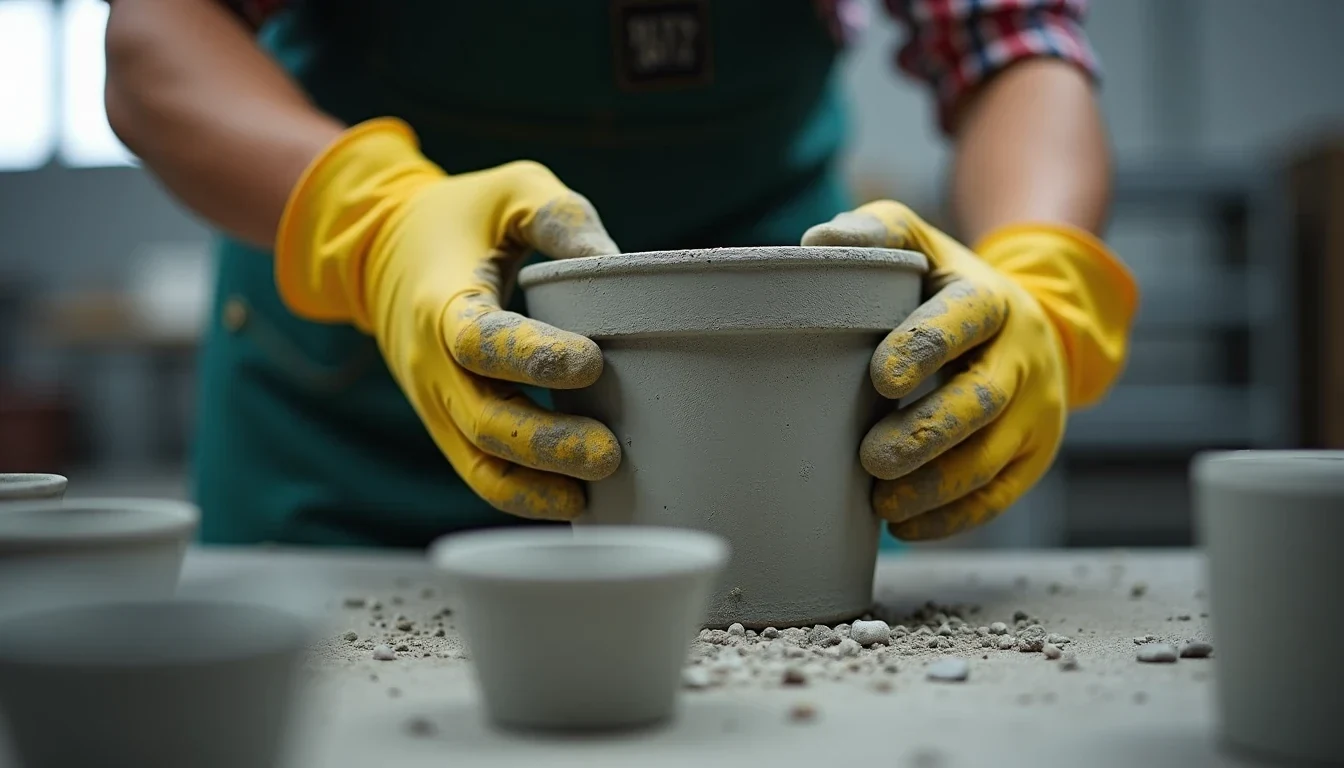
A concrete pot is not a business. It is a heavy object that cracks if you get the water ratio wrong. During the pandemic, one Centurion family made enough of them to fill a factory. The leap from “we need something for the patio” to “we need a mixer that can handle 200 litres” should not have worked. It did.
Kainos Garden now operates from a manufacturing floor in Centurion, Pretoria, shipping garden pots, water features, and ornamental pieces across most of Gauteng. The name pulls from the Greek kainos, meaning new or fresh. This reads as standard founder optimism until you learn what the word actually replaced: months of failed batches, cracked moulds, and a growing suspicion that the local market for garden decor offered either cheap junk or imports priced for someone else’s economy.
The gap nobody else was filling
The founders started gardening in 2020, like half the country. Unlike most, they could not find pots that survived a full season of Highveld sun without fading, cracking, or simply looking like an afterthought. Available options sorted into two piles. Mass-produced plastic and thin terracotta cost little and delivered less. Premium concrete pieces, mostly imported, carried price tags that assumed a euro or dollar conversion rate and a customer who did not flinch at freight.
This is where the business starts: not with a vision statement, but with irritation. The family began mixing concrete in small batches, testing ratios, watching what happened when temperatures swung between 15 and 35 degrees in a single spring afternoon. South African climate stress is not abstract. Thermal expansion kills poorly formulated concrete, and UV degradation turns surface finishes chalky within two seasons. Their proprietary mix, developed over those early months, was specifically tuned for local conditions: high compressive strength, controlled porosity for drainage, and a surface treatment that holds pigment without the plastic sheen of resin coatings.
The product range now spans standard garden pots, custom dimensional pieces, integrated water features, and full ornamental installations. Delivery runs across Gauteng, which indicates the weight and logistics involved. A 60cm concrete bowl starts at roughly 35 kilograms. Moving that at scale requires either a fleet arrangement or a customer base concentrated enough to make route planning rational. Centurion sits at the junction of the N1 and N14, with Pretoria to the north and Johannesburg’s northern suburbs to the south. The location is practical, not romantic.
What scaling actually required
The research pack mentions “proprietary concrete formula” like it is a single insight. In practice, it is a chain of controlled variables that break constantly. Kainos Garden had to solve for material sourcing consistency, which means cement from the same mill, aggregates with stable gradation, and admixtures that do not vary batch to batch. South African construction supply chains are not known for predictability. Load shedding disrupts production schedules. Supplier credit terms for small manufacturers run short. The family built relationships with specific, vetted local suppliers rather than chasing lowest unit cost. This decision separates hobbyists from operations that survive audit.
Moulds presented the next constraint. DIY concrete work uses single-use or low-cycle forms: timber, basic silicone, whatever holds shape once. Manufacturing requires moulds that survive hundreds of casts without dimensional drift. Silicone and fibreglass composite moulds carry upfront costs that bite a small operation. However, the per-unit economics only work if amortisation stretches across sufficient volume. Kainos Garden invested in durable formwork systems early, betting on throughput before throughput was guaranteed.
Curing control came after that. Concrete reaches design strength through hydration, a chemical process that needs stable temperature and humidity. Uncovered curing in a Gauteng factory yard produces surface cracking, colour variation, and weakened edges. The operation implemented covered curing zones with misting capacity. This sounds minor until you calculate the water and power requirements, and the backup systems needed for load shedding periods.
Quality protocols run from raw material inspection through to post-demould dimensional checks. The company solicits customer feedback for continuous refinement of both product and process. This is not marketing language. In a small manufacturing operation, the person handling complaints is often the same person adjusting the mix the next morning. Feedback loops are short because there is no organisational distance to cross.
The business model and who pays
Kainos Garden targets two customer segments that do not obviously overlap: experienced gardeners with established landscapes and beginners looking for entry-level pieces that will not need replacement in eighteen months. The product architecture supports this split. Standard lines cover common sizes and finishes at price points accessible to new entrants. Custom work, including bespoke dimensions and integrated water features, serves the higher end where landscaping budgets run into five figures and the pot is specified by a designer rather than selected from a shelf.
The family-run structure helps here. Founders who mix the product, handle sales, and manage delivery retain margin that would otherwise fund a layer of middle management. Labour costs in South African manufacturing are low relative to capital equipment, but regulatory compliance, UIF contributions, and workplace safety requirements add administrative overhead. A lean family operation can absorb this more flexibly than a formally structured entity with external shareholders.
Their stated ambition is market leadership in garden ornaments, pots, and landscaping services. This is not a small claim. The South African horticultural retail sector includes established nursery chains with national footprint, import distributors with direct China relationships, and a long tail of informal producers working at township and peri-urban scale. Kainos Garden’s bet is that local manufacturing precision, combined with custom capability and Gauteng-specific delivery logistics, creates a defensible position in the premium-to-mid market band.
What this means for other creative economy operators
The pandemic founding story is now common enough to be a genre. What distinguishes the cases that survive is not the origin moment but the operational decisions that followed. Kainos Garden’s trajectory offers specific, transferable lessons for South African creative entrepreneurs working in physical product.
First, the market gap was identified through direct experience of product failure. The founders did not conduct focus groups. They tried to buy something, found it deficient, and reverse-engineered the alternative. This pattern, personal frustration as market research, recurs across successful local manufacturing startups because formal market intelligence is expensive and often outdated for niche categories.
Second, the proprietary advantage is not branding or design alone. It is material science tuned to local conditions. South African creative businesses frequently underinvest in technical R&D, preferring to differentiate through aesthetic styling. Kainos Garden’s months of formulation work created a production barrier that styling alone cannot cross.
Third, the geographic choice of Centurion reflects logistics mathematics rather than founder residence. Creative economy operators often default to fashionable locations, Jozi inner-city or Cape Town fringe, without modelling delivery radius, supplier access, and labour pool against revenue per kilogram. For heavy goods, the calculation reverses. You need highway access and warehouse space at industrial rates, not creative district credibility.
Fourth, the family structure is not a sentimental detail. It is a cash-flow management strategy. Early-stage manufacturing in South Africa faces a working capital squeeze: materials must be paid for before production, and customer payment terms often stretch 30 days post-delivery. Founders who can defer personal drawings and reinvest margin extend runway without external financing, which is scarce for unproven physical product ventures.
The company’s range now includes everything from standard planters to substantial water features. They produce custom concrete garden pots to client specification. The link between product breadth and manufacturing confidence is direct. You do not add water features, with their pump integration and waterproofing requirements, until your core casting process is sufficiently controlled to handle compound assemblies.
The harder part still ahead
Market leadership in this category will require more than manufacturing competence. It needs either national distribution, which challenges the weight economics, or brand positioning strong enough to command premium pricing that funds freight. The landscaping services extension, mentioned in the company’s stated ambitions, is a logical adjacency. Installation work generates higher revenue per transaction and locks in product specification. It also shifts the business toward project-based workflow, with all the estimation risk and client management overhead that entails.
For now, Kainos Garden has built something more unusual than the origin story suggests: a pandemic hobby that survived the transition to formal manufacturing, in a sector where most local producers stay informal and most formal players import. The concrete is mixed in Centurion. The moulds are cycled on-site. The delivery trucks run Gauteng routes. Whether that operational footprint can scale to national presence, or whether national presence is even the right goal, is the question the next phase will answer.
The garden pot market does not generate much press coverage. It is not a venture capital category. The metrics that matter are batch consistency, mould cycle life, and whether a 45-kilogram water feature arrives intact in Benoni. Kainos Garden’s founders learned to measure those metrics because the alternative was shipping broken concrete and absorbing the replacement cost. That education does not appear on pitch decks, and it determines whether a pandemic project becomes a business that outlasts the memory of why it started.